

German businesses need a successor every year.
The Precision Manufactory
Preserving Europe's precision manufacturing advantage.
Europe's precision-manufacturing capability lives inside some 50,000 specialist workshops, and thousands of them have no successor. We acquire them, preserve what makes them exceptional, and connect them through VinOS, our AI-native operating layer.
50,000Specialist precision SMEs in the German Mittelstand
15,000Of them facing a succession crisis
<€20MTurnover for half of those: too small for conventional M&A
The problem · 01 / 04
50,000Specialist workshops hold Europe's precision capability.
The core of it sits inside roughly 50,000 specialist SMEs, a sliver of the 3.8 million that make up the German Mittelstand. The knowledge is real, but it's scattered.
The problem · 02 / 04
15,000Nearly a third have no successor.
No family member to take over. No institution set up to inherit what they know.
The problem · 03 / 04
−15,000When the founder retires, the workshop closes.
And the capability is gone for good: the tolerances, the sequencing, the customer knowledge built over decades.
The problem · 04 / 04
8sectorsNeeded faster than at any point in living memory.
Defence, space-tech, med-tech, energy, AI infrastructure, quantum, auto-autonomy and semiconductor devices all depend on it. The capability the world needs is disappearing.
50,000 workshops1 square = 10 workshops · to scale
Specialist SMENo successor1 = 10 workshops
The succession cliff
Every year, a generation of know-how looks for a successor.
Spectrum's crisis was not unique. It was, in miniature, the defining problem of the European Mittelstand.
SME transfers will be required by the end of 2027.
of Germany's 3.7 million SME owners are over 60.
of owners planning to close cite one reason: no suitable successor in the family.
Source: KfW Research, as cited in “Belief Engineering” by Mukul Pandya. Bars: first two drawn relative to 626,000; last two as shares.
The founder-system
Pull out the founder and the operating system goes with them.
An organisation so dependent on one person's daily cognitive load that removing them is like pulling the operating system out of a computer.
At Spectrum, the nuances of client preferences, machining tolerances and production sequencing for 65,000 parts existed only as tacit knowledge in the founder's head. That's the knowledge we exist to preserve.
Our operating idea
Complex underneath. Simple on the surface.
Our mark is built the way we build the business: four separately machined modules, held to one tolerance, locked into a single form. Each module stands for one principle.
01
Preserve
Module · FrameTop bar + upper stem
Protect generations of engineering knowledge and craftsmanship: the tacit expertise that usually lives in one founder's head.
02
Distil
Module · UprightRight side of the bowl
Turn complex capability into understandable systems. At Spectrum, 65,000 parts became a handful of product families.
03
Connect
Module · ShelfThe 45° plane
Connect customers, engineering expertise, equipment, people and manufacturers through one operating layer. The shelf crosses the stem: it's the piece that locks the others together.
04
Scale
Module · FootChamfered lower stem
Let specialist capability operate as part of something much larger than any single workshop could be alone.
Four modules · one tolerance
Fragmented capability, precisely joined into one whole.
Every gap is the same 5 units. Every angle is 0°, 90° or 45°. Nothing is drawn by eye, and nothing in the business is either.
00 / 04
The playbook
Four stages, from acquisition to scale.
Precision Manufactory is productising and platformising the approach that worked at Spectrum. We work with IP-rich niche manufacturers, typically €1M–€15M turnover, whose founder has no successor.
0104
Stage 01
Acquire
A Spectrum-lookalike: a specialist manufacturer with validated products and loyal customers, but no successor.
Stage 02
Capture
The entire capability of the business is captured in VinOS: tolerances, sequencing, client preferences and more.
Stage 03
Distil
The catalogue is condensed into standard product families, simplifying the path from customer need to order book.
Stage 04
Scale
The same backbone extends to other SMEs in the network, maximising the throughput of the whole network.
Who we work with
Deep niches, where know-how is the advantage.
“Where there is a non-differentiated offering, just optimising operations would not solve it. But when there is a deep niche, preserving the know-how is what creates the differentiated advantage.”
VinOS
The operating layer behind the machines.
Not a chatbot bolted onto a factory. VinOS is infrastructure: an AI-native operating system that captures the entire capability of a specialist manufacturer and runs like an assistive middle-management layer for the owner and the workforce.
Collate
Gathers the catalogue, the order book and the production plan into one place, out of one person's head.
Simplify
Distils complex catalogues into product families that are simple to book and produce.
Optimise
Maps people and machines to the order book, so every hour of shop floor counts.
Connect
Extends the same backbone to every SME in the network, maximising the throughput of the whole.
Inside VinOS
An operative muscle over a systematic skeleton.
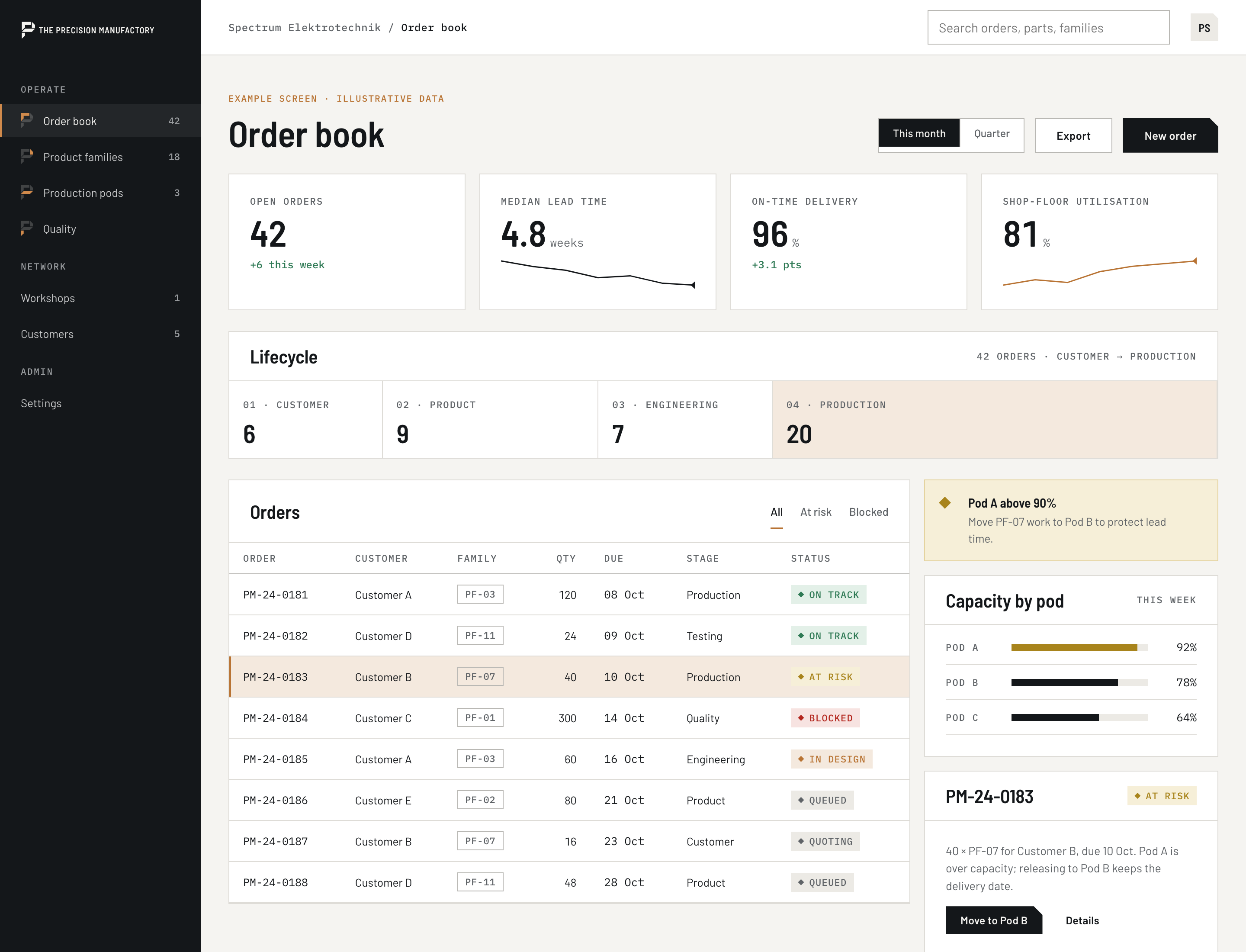
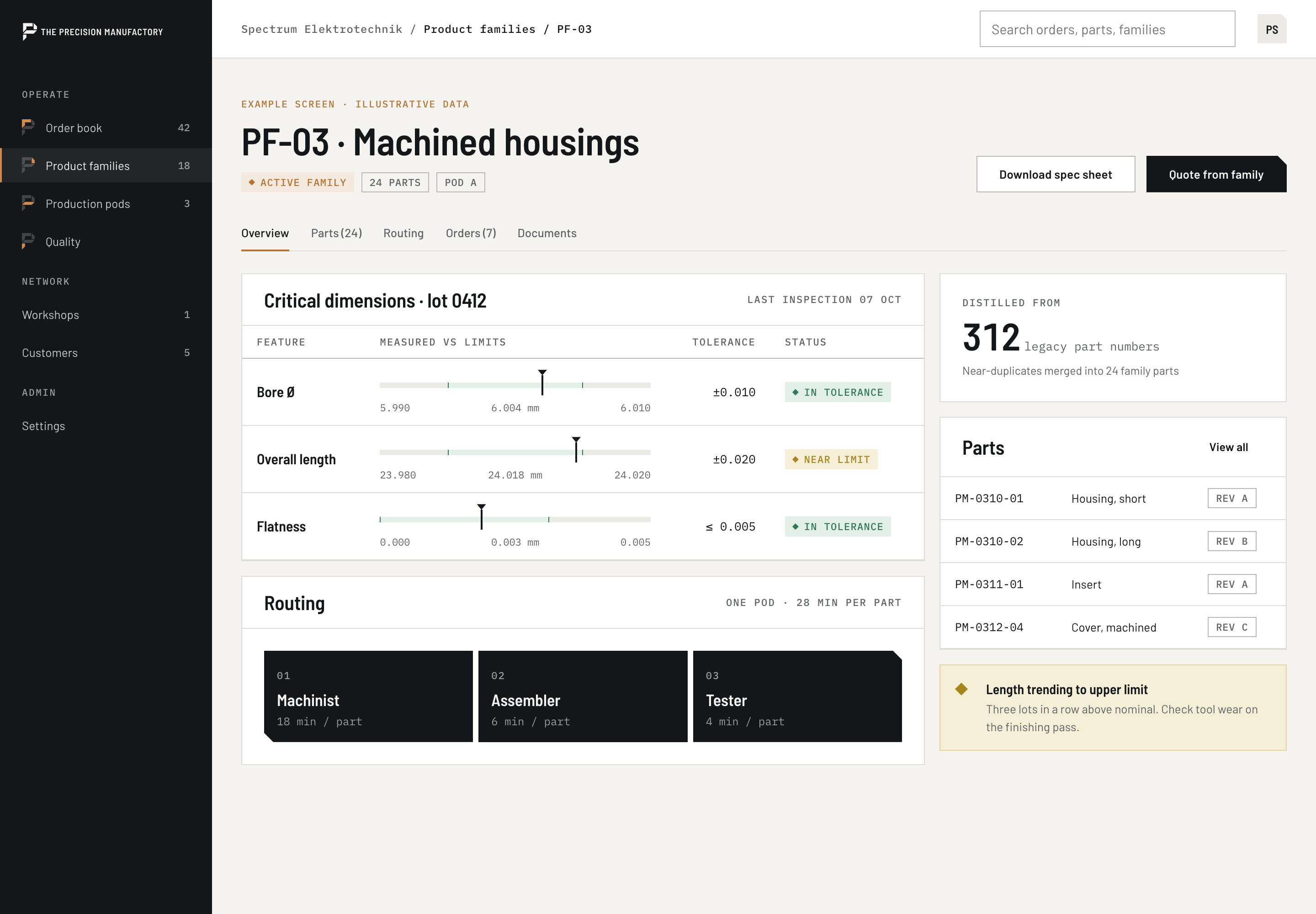
At Spectrum the only digital infrastructure was an IBM AS/400, used as a static data repository. There was no middle-management layer at all. VinOS becomes the layer that holds the catalogue, the order book and the production plan, so the business no longer depends on a single person to run.
Example screens · illustrative data
Where it goes next
The connecting layer with physical AI.
As specialised manufacturing tasks become increasingly automated, VinOS becomes the layer that connects them. That's what unlocks the real prize: a shift in the unit economics of precision-component manufacturing. Modern AI tools bring the rigour of a manufacturing giant to micro-fragmented SMEs.
- 01Design
- 02Production input
- 03Defect detection
- 04Inspection
Proof · Spectrum Elektrotechnik GmbH, Munich
“I didn't see a dead company. I saw trapped kinetic energy.”
Spectrum's parts enabled radio-wave and microwave communication between aircraft and ground stations, in commercial aviation, military systems and spacecraft. High-mix, low-volume, made-to-order work at the extreme end of precision. At its peak it served 200+ customers, including Airbus, Boeing and SpaceX.
By October 2024 it was a silent 4,000 m² facility with six people. Yet five blue-chip clients stayed loyal: defence labs, aerospace manufacturers and space agencies across India, Israel, the United States, Spain and South Korea. The product-market fit had been solved decades earlier. What was missing was a system.
Founded1981, Munich
SpecialismRF & microwave
Facility4,000 m² · 13 CNC
StatusOut of turnaround
Timeline
From founding to full turnaround.
Scroll through the life of the shop floor. Machines and people drawn one square each.
1981
Founded
Peter von Nordheim founds Spectrum in Munich and runs it for four decades. At its peak: 60–70 people, 200+ customers and €3.5M a year.
2023
Posted for liquidation
July 2023. Consultants conclude the decline is irreversible.
2024
A silent factory
October 2024. Six people remain, living on ~€30K a month from depleting stock. Thirteen CNC machines stand still.
2025
Execution begins
March 2025. The founder hands over. The old functional heads are brought back, and new machinists train under them.
2025
Out of turnaround
August 2025. €600K+ monthly revenue and a ~€7M annual run rate, with a team of about 30.
CNC machines · 13Running
People · 1 square each60–70
Monthly revenue · to scale~€290K
Peak: €3.5M a year, shown as a monthly averageDistil
65,000 parts, distilled.
Staffing for peak output across the whole catalogue had compressed margins for years. The catalogue was condensed into narrow product families, then focused where demand was highest.
65,000
Unique parts · 40 years
~2,500
Parts where demand was highest
~1,000
Truly distinct components
Drawn to scale · one tick = 1,000 parts
Rebuild
Production, reorganised into pods.
Each pod pairs one machinist, one assembler and one tester, mapped to five to ten product families. With product simplification and proper production planning, 15 to 20 production staff could match the output that 60 to 70 had struggled to achieve.
Pod A5–10 families
MachinistAssemblerTester
Pod B5–10 families
MachinistAssemblerTester
Pod C5–10 families
MachinistAssemblerTester
Before · production staff at peak
60–70
After · matching the output
15–20
Invest in the people
Salaries rose 8% across the board, against a market norm of 2–3%, and the traditional Easter bonus was kept, even while the company was still making losses.
Protect the quality
Outsourced parts were rejected. New machinists trained under Spectrum's legacy functional heads until quality matched the historic standard.
Build a bridge
The finance controller, with Spectrum from the beginning and trusted by everyone on the floor, was elevated to co-Managing Director.
Results
A quarter of the lead time. Double the historical peak.
“Because we solved their supply chain anxiety, they gladly solved our cash flow issues.”
Delivery time
4–6 wks14–20 wks
Payment cycle
30 days120 days
Annual revenue
~€7M€3.5M
EBITDA margin
~40%10–15%
Team
~3060–70
Bars drawn to linear scale within each row, using range maxima (20 wks, 70 people) and the upper margin (15%). Figures as reported in “Belief Engineering” (Mukul Pandya) and the Precision Manufactory write-up, as of August 2025. “Now” revenue is a run rate.
4–6Weeks to deliver, down from 14–20
€600K+Monthly revenue by Aug 2025, from ~€30K
~40%EBITDA margin, vs 10–15% at its historical peak
What Spectrum taught us
Lessons from the shop floor, not a textbook.
Every principle below came from lived experience in a silent Munich factory, and now shapes how we approach every acquisition.
Keep the craft with the craftsmen
The first step was to bring back the old functional heads and rely on their institutional memory. New machinists trained under them.
“The craft is preserved in the original craftsman.”
Never cut costs inside the moat
Outsourced sample parts came back functional but below Spectrum's historic standard. They were rejected, and quality was rebuilt in-house until it matched.
“Never cut costs inside your competitive moat.”
Find the bridge person
Every acquisition needs someone the legacy workforce already trusts. Elevating the long-serving finance controller to co-Managing Director dissolved cultural barriers overnight.
Start with the minimum viable unit
Consultants proposed a sequential two-to-three-year modernisation. Instead: find the smallest unit that works, make it work, then build on top.
“Make it work first, and build on top of it.”
What precision manufacturing is
From a millimetre to a nanometre.
1.000000MM
Tolerance band · 1 mm
The collection of manufacturing techniques that deliver a functional or dimensional tolerance anywhere from a millimetre down to a nanometre. It has long been Europe's industrial edge, led by Germany, Switzerland, Austria and Italy.
01Technology
02Equipment
03Skill
FIELD OF VIEW
10 MM
×1
LOG SCALE · 6 DECADES
Ambition
The first mega precision-component factory of the future.
Productising and platformising the entire approach, to preserve, connect and scale this capability. Not only the 8,000 precision-manufacturing SMEs at risk of disappearing, but raising the capability of all 50,000.
Precision SMEs at risk8,000
Specialist SMEs in scope50,000
Operating layer1
“If we allow these businesses to face extinction, we are burning down the libraries of European engineering heritage.”
Start a conversation
We're looking for the next Spectrum.
Three ways in. Every conversation starts the same way: by understanding what makes the business exceptional.